California almonds: an ancient crop at the center of climate risk, mitigation, and adaptation
By Sierra Chapin-Keller
February 27, 2026
10 MIN READ
Our Quarterly Good Food Bulletin brings together company news, supply chain updates, and climate insights from our partners to help you navigate the evolving food and retail landscape.
Want it every quarter?
Sign up hereAlmonds occupy a complicated place in the climate discussion. On the one hand, they are among the most efficient sources of plant-based protein and healthy fats, produced by long-lived perennial trees that store carbon to help mitigate climate change and support circular farming practices. Yet they are highly sensitive to climate risks, particularly prolonged drought, extreme heat, declining winter chill, and the cascading pollinator stress that follows from those conditions, and require adaptive practices to thrive into the future.
This tension sits at the heart of the almond story. Upwards of 80% of the global almond supply is currently produced in California, and the same orchards that help store carbon and feed millions are growing increasingly exposed to climate conditions that threaten their productivity and long-term resilience. As drought intensifies, trees experience stress that limits their ability to grow fruit and sequester carbon. Rising temperatures and erratic winters disrupt bloom timing and reduce chill accumulation, weakening yields. Like many perennial ecosystems, the ability of almond trees to thrive as a crop and provide benefits like carbon sequestration depends on their overall health, which climate change is steadily eroding.
Nowhere is this contradiction more visible than in California’s Central Valley, where long-lived orchards store carbon even as growers face intensifying drought, heat, and pollinator stress. This tension has major implications for growers, suppliers, distributors, and the global food system that depends on a reliable supply of this nutrient-rich crop. Climate adaptation provides a critical set of strategies to help sustain the industry into the future as these pressures continue to intensify.
A brief history of almonds
As global climates stabilized about 12,000 years ago, permanent agriculture took root in many places around the world, and almonds became one of the earliest domesticated tree crops. Although commonly referred to as nuts, almonds are actually the edible seeds of a stone fruit, or a drupe, with a fleshy outer hull that splits open at maturity to reveal the hard shell and seed inside. They were likely chosen in ancient times because they can be grown from seed, which was easier than grafting, an agricultural method that came later.
Almonds thrive in Mediterranean climates, where hot, dry summers support nut maturation and mild, wet winters enable proper dormancy and bud development. Although their precise origin is debated, botanical and archaeological evidence places wild and early cultivated almonds across a broad region spanning Central Asia, Iran, Turkmenistan, Tajikistan, Kurdistan, Afghanistan, and Iraq, with additional assessments identifying an eastern subregion between Mongolia and Uzbekistan as part of their early range.
Other sources point to West Asia, particularly the Levant, as a key center of early cultivation, and recent scholarship highlights Iran and Anatolia (modern-day Turkey) as primary origin centers. Wild relatives also grew in parts of the Levant, where almonds appear in Early Bronze Age (3000-2000 BCE) contexts, including finds in present-day Jordan, and their cultural significance is underscored by their presence in King Tutankhaman’s tomb. From these early centers, human cultivation spread almonds westward along Mediterranean trade routes into North Africa and Southern Europe, and much later to regions such as California, where the crop now flourishes under similar climatic conditions.
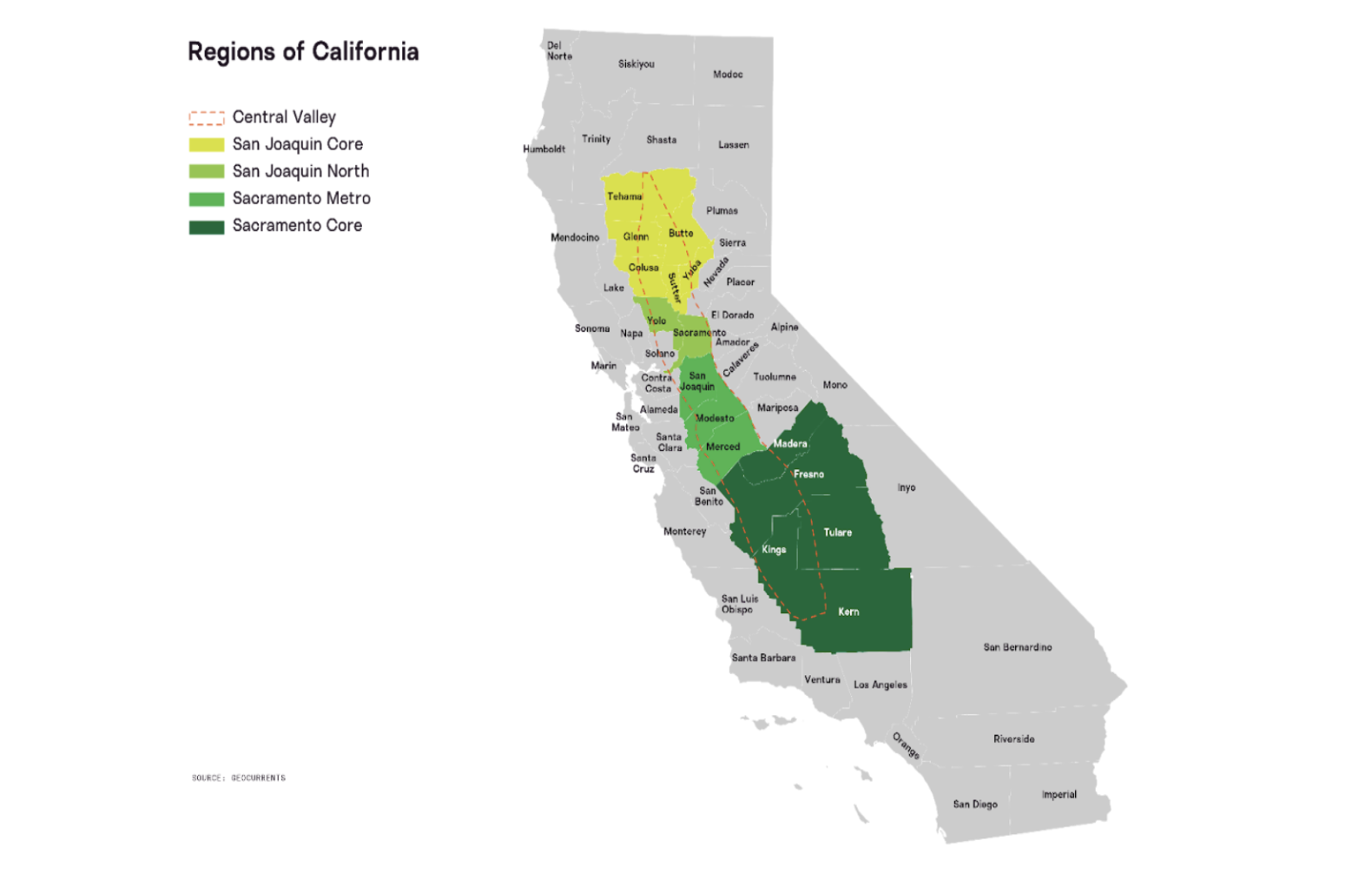
Today, that long arc of cultivation culminates in California’s Central Valley, where Mediterranean-like climate conditions have supported more than 1.5 million acres of orchards stretching from Kern County north to Tehama.1
The state accounts for 80% of global almond production and supplies the entire U.S. commercial market.2 Almonds represent California’s leading crop-based agricultural export, with an estimated value of $5.66 billion in 2024.3 This economic significance also exposes the crop to heightened risk: unlike the stable climate conditions that supported almond domestication thousands of years ago, California now faces increasing climate pressures that threaten the long-term sustainability of its orchards.
Projections indicate that by 2060, ongoing climate change may reduce almond yields by 20%.4
Climate threats to almonds
Permanent agriculture flourished under the exceptionally stable Holocene climate, which eventually supported the domestication of crops such as almonds. Today, as California shifts into a period of accelerating climate stability, that same crop faces mounting pressures that threaten its long-term viability. Although almonds offer certain climate benefits, they remain highly sensitive to climate change. Their biological requirements, including cool winters, mild springs, reliable water sources, and robust pollinator populations, are increasingly challenging to satisfy as global temperatures rise.
Most almond orchards are concentrated in the Central Valley, particularly the southern San Joaquin Valley, and increasingly, the northern Sacramento Valley. These are both regions within California’s Central Valley that are experiencing, or are expected to soon experience, intensifying climate pressures.
Water scarcity and drought intensification
Almond cultivation frequently draws scrutiny for its water requirements. Although almonds are not exceptionally water-intensive relative to other perennial crops, their production is concentrated in regions facing persistent water scarcity.
In California’s San Joaquin Core, which spans the southern two-thirds of the Central Valley and includes Kern, Tulare, Kings, Fresno, and Madera counties, drought has become a recurrent event over the past two decades. Climate models predict that California droughts will, in general, become more frequent and severe, particularly across the Central Valley, where almonds are primarily grown. This will further diminish water availability and intensify competition among agriculture, urban areas, and natural ecosystems.
At 0.5°C of warming, the historic baseline climate from 1971-2000, Probable Futures’ maps indicate that all of California, including Kern County, California’s top almond-producing county, faced an annual likelihood of year-plus drought between 11 and 33%. At 1°C of warming in the recent past climate between 2010 and 2015, Kern County itself remains in the 11-33% range, but surrounding areas begin to shift into the 34-50% likelihood category, signaling a regional increase in drought risk even before Kern’s own risk level changes. By 2.5°C of warming, a future scenario likely to occur in the 2050s, most of Kern County and the broader San Joaquin Core are projected to face between a 34 and 50% annual likelihood of year-plus drought, with some locations reaching 51-67%. When likelihood exceeds 50% in any location, year-plus drought is more common than not, and is likely to occur more than half the time, or more frequently than once in two years.
In addition to climate drought conditions, there are government programs meant to conserve water in the long term that can make it harder for farmers to irrigate under existing drought conditions. These restrictions can force growers to leave orchards unsown temporarily or transition to crops with lower water requirements.5
Insufficient water and drought stress reduce yields, weaken trees, harm pollinators, and heighten vulnerability to pests and diseases, ultimately shortening orchard lifespan and diminishing the long-term climate benefits of carbon storage.
Extreme heat
Almonds are highly susceptible to heat waves during bloom6 and nut set, the stage when successfully pollinated flowers transition into developing young nuts. Temperatures exceeding 95°F (35°C) can damage flowers, reduce pollination success, and decrease kernel size.7 Elevated temperatures also negatively affect kernel quality, leading to increased rates of shrivel and reduced market value. Prolonged exposure to extreme heat can decrease tree longevity, thereby diminishing the climate efficiency of perennial cropping systems.
At roughly 0.5°C of global warming, which was between the years 1970 and 2000, Probable Futures’ maps show Bakersfield in central Kern County experiencing between one and four months above 95°F (35°C). At 1.5°C of warming, which is the level of warming we are experiencing now, central Kern County faces between two and four and a half months of extreme heat. Under a 3°C warming scenario, a potential future outcome, the same area will endure extreme heat for between three and five months each year in most years.
Declining winter chill hours
Almonds require a minimum of 250 to 350 winter chill hours, defined as hours between 32°F (0°C) and 45°F (7.2°C), in order to break dormancy and achieve uniform bloom.8 Rising winter temperatures are reducing chill accumulation9 in key almond-producing regions, a trend that is intensified by the decline of the Central Valley’s historic “tule fog”. Once a reliable source of cool, dense, winter air, tule fog has become less frequent and less persistent as the region warms, further limiting the conditions needed for chill to accumulate. Research from UC Davis projects that by 2050, many growing seasons in parts of the Central Valley may not meet the required chill threshold.10 Insufficient chill results in delayed and uneven bloom, suboptimal pollination, and decreased yields.
Pollinator stress
Almond production relies heavily on honeybees and other pollinating species. Each January and February, over 2 million honeybee colonies, roughly 80% of U.S. commercial hives, are transported to California’s Central Valley for the annual almond bloom.
Climate change disrupts this relationship in several ways. Heat and drought conditions reduce the floral resources available to bees both before and after almond bloom. Additionally, altered bloom timing can lead to a mismatch between bee foraging activity and flower availability.11 Finally, drought-stressed trees produce fewer flowers, and higher temperatures increase disease pressure on bee colonies.12
In the southern San Joaquin Valley, where drought has been most persistent, a report published in “Environmental Science and Technology” by researchers from the University of Pittsburgh and Penn State found that the demand for pollinator-dependent crops like almonds, blueberries, and apples has grown over 300 percent globally over the past 50 years, yet U.S. regions most reliant on insect pollinators often have some of the poorest habitat, with regular pesticide use, and limited, diverse flowering plants.13
The California almond industry has supported pollinator health through initiatives such as grants to the Pollinator Habitat Program, the formation of the California Pollinator Coalition, and the introduction of legislation, including AB 1042, a Managed Honeybee Health Program. Despite these efforts, climate-driven stressors continue to threaten both bee populations and crop yields.
Climate mitigating powers of almond groves
In addition to being susceptible to climate risks, almond groves can serve as valuable tools for mitigating greenhouse gas emissions, making it even more important for this industry to adapt into the future.
Carbon storage in perennial orchards
In contrast to annual crops that are planted and harvested within a single season, almond trees are perennial and store carbon in woody biomass and soil over the lifespan of the orchard. Research from the California Air Resources Board indicates that mature almond orchards can store between 18 metric tons of carbon per acre per year.14
Compared with annual crops such as lettuce or tomatoes, which have short carbon cycles and minimal woody biomass, almond orchards function more like small forests. The long-term carbon storage provided by almonds represents a frequently overlooked climate benefit of nut crops.
Low-carbon footprint for a nutrient-dense food
Almonds also perform favorably when greenhouse gas emissions are assessed on a per-nutrient-dense-calorie or per-gram-of-protein basis. According to a life cycle assessment by the UC Davis Almond Sustainability Program, almonds generate approximately 0.7 to 1.6 kg CO2e per kilogram of nuts.15 The value is significantly lower than that of dairy proteins and is comparable to other plant-based proteins.
A portion of this efficiency is attributable to the utilization of almond byproducts. Hulls are widely repurposed as livestock feed, and shells are routinely used as bedding or biofuel across the industry, while woody biomass from removed orchards is increasingly being converted into renewable energy or biochar as new partnerships and infrastructure expand these pathways. These circular pathways reduce waste and displace materials with higher carbon intensity.
Contemporary orchard management practices have contributed to a reduction in emissions intensity. The adoption of precision agricultural technologies, including micro-irrigation, soil moisture sensors, and variable-rate nutrient application, has decreased fertilizer use and improved water efficiency. Additionally, the implementation of solar-powered processing facilities and electric irrigation pumps has further minimized the carbon footprint. Drip and micro-sprinkler irrigation systems are now predominant in California orchards, reducing water use by up to 33% compared to flood irrigation.16 Many processors have transitioned to renewable energy sources, and some are piloting anaerobic digestion of hulls and shells to generate biogas.17
Waste-to-value pathways are expanding within the industry. Biochar produced from orchard biomass can be applied back to soils, enhancing fertility and sequestering carbon for extended periods. Almond hulls are increasingly utilized in mushroom cultivation and the production of insect protein, including black soldier fly larvae, mealworms, crickets, and grasshoppers. This insect protein serves as a sustainable ingredient in livestock feed, pet food, and even select human food products, such as protein powders, fortified flour, and snack bars. These innovations enhance the climate profile of almond production and help offset emissions associated with water pumping and fertilizer application.
Some growers are also adopting regenerative practices that improve both climate outcomes and ecological resilience. For example, RPAC LLC Almond Grower and Processor partners with growers who have implemented a comprehensive set of practices across multiple orchards, including the establishment of over 6,000 feet of hedgerows to support pollinators and beneficial insects, applications of compost to enhance soil health, use of pheromone‑based mating disruption for navel orangeworm control, and planting of diverse cover crops to improve soil structure and habitat. On the ranch where these practices are implemented, RPAC partners produced their entire 2025 crop without insecticides.
Climate adaptation: How California growers are responding
California almond growers are reading the forecasts of climate science and responding with adaptive strategies.
For example, some growers are actively reshaping production geography in response to tightening water supplies and SGMA restrictions. Growers are shifting new plantings northward, from historically high-yielding but water-stressed counties like Kern and Tulare, toward Sacramento, Yolo, and San Joaquin, where surface-water supplies are more reliable. Many growers had minimal or no acreage in these areas five years ago. Although these regions may yield less, they offer greater water certainty, which is now a decisive factor in long-term orchard planning.
Breeding and Rootstock Advances
Breeding programs are producing drought-tolerant, heat-resilient, and low-chill almond varieties. New rootstocks enhance water-use efficiency and disease resistance. Self-fertile varieties18, such as “Independence,” reduce reliance on pollinators, though bees remain necessary for optimal production.
Regenerative and Adaptive Growing Practices
Growers are implementing practices that enhance soil health, increase water retention, and reduce vulnerability to climate extremes. These strategies include using cover crops to improve soil structure and moisture retention, applying compost and mulch to reduce evaporation, and adopting precise irrigation methods to maximize water efficiency. Additionally, many growers are establishing hedgerows and other habitat features to support pollinators,19 while others are investigating biochar to increase soil carbon.20 Collectively, these approaches lower emissions and improve orchard resilience to drought and heat.
Almond production into the future
As drought, extreme heat, declining chill hours, and pollinator stress intensify, the future of almond production will depend on continued innovation, adaptation, and effective water stewardship. With the global almond supply so tightly concentrated in California, the crop’s long-term viability hinges on how the state navigates rising temperatures, water scarcity, and ecological stress. Almonds can remain a helpful force for climate mitigation, but only if growers, policymakers, and industry leaders continue to invest in practices and technologies that strengthen resilience and reduce environmental impact.

Sources:
1. Almond Board of California. “Standing Acreage Final Reports.” Almonds.com. Accessed February 17, 2026.
2. California Department of Food and Agriculture. California Agriculture Exports 2019–2020. 2020. Archived PDF from December 8, 2023. Accessed February 11, 2026.
3. California Department of Food and Agriculture. “Statistics.” Accessed February 11, 2026.
4. Pathak, T.B.; Maskey, M.L.; Dahlberg, J.A.; Kearns, F.; Bali, K.M.; Zaccaria, D. Climate change trends and impacts on California Agriculture: A detailed review. Agronomy 2018, 8, 25. [Google Scholar] [CrossRef]
5. Valley Ag Voice. “SGMA’s Groundwater Costs Could Slash Fruit and Nut Production, Study Finds.” Accessed February 11, 2026.
6. González-Martínez, Enrique, Jaume Lordan, Sergi Munné-Bosch, and Xavier Miarnau. “Impact of Rising Temperatures during Dormancy on Key Yield Components in Almond.” Scientia Horticulturae 355 (2026).
7. Growing Produce. “Many Factors Can Affect Almond Size and Quality.” Accessed February 11, 2026.
8. California Office of Environmental Health Hazard Assessment. “Winter Chill.” Accessed February 11, 2026.
9. Climate Central. “California’s Winter Fog May Be Disappearing.” Climate Central. Accessed Februay 17, 2026.
10. Baldocchi, Dennis, and Sophia Wong. “Winter Chill Decline in California’s Central Valley.” UC Davis, 2020.
11. Gross, Liza. “Extreme Heat Poses an Emerging Threat to Food Crops.” Inside Climate News. Published September 9, 2022. Accessed February 11, 2026.
12. UC Davis. “Bees Face Many Challenges — and Climate Change Is Ratcheting Up the Pressure.” Accessed February 11, 2026. However, climate-driven stressors continue to pose risks to both bees and yields.
13. UC Berkeley Graduate School of Journalism. “California’s Almond Trees.” Berkeley Journalism. Accessed February 17, 2026.
14. California Air Resources Board. An Inventory of Ecosystem Carbon in California’s Natural & Working Lands. 2020.
15. University of California, Davis. “Almonds Contribute Little to Carbon Emissions, Study Finds.” Accessed February 11, 2026.
16. Cultivate California. “Using Water.” Accessed February 11, 2026.
17. Almond Board of California. “Almond Board Explores Alternative Uses for Almond Byproducts.” Accessed February 11, 2026.
18. California Department of Food and Agriculture. California Climate Change Consortium Report. Accessed February 11, 2026.
19. USDA Climate Hubs. “Climate Vulnerabilities of California Specialty Crops.” Accessed February 11, 2026.
20. Almond Board of California. “Biosolari—Say What? New Research Combines Hulls, Shells and Soil.” Accessed February 11, 2026.
Share on


